Poverty
The Best Werewolf Short Stories 1800-1849Poverty functions in the narrative as a lived system of deprivation rather than a temporary misfortune. It strips families of shelter, food, health, social protection, and public identity; yet it also exposes the cruelty of the communities and institutions that claim to judge them. For the Wulfrics, poverty is inseparable from the werewolf stigma imposed upon their name. For Gaspar de Marcanville and Adéle de Marcanville, it is the material consequence of exile and political betrayal, forcing a fallen noble household into concealment and subsistence hunting.
Material Conditions and Social Exclusion
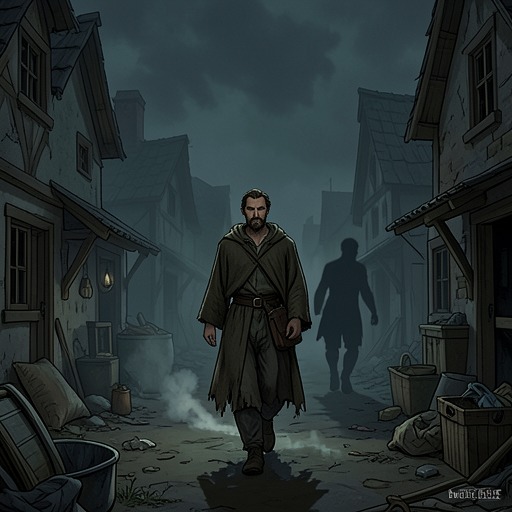
The Wulfrics inhabit a rude hut made of chalk and clay, roofed with straw whose large rents admit the high winds. Its rotten door is full of gaps, and the isolated dwelling becomes still more remote in the eyes of neighboring serfs whenever marsh vapors mingle with twilight. At the hour associated with the saying “between dog and wolf,” will-o’-the-wisps glimmer around the hut, and fear prevents ordinary human approach. The household eats patriarchally when it has any supper at all, then retires to rest; poverty here is measured not only by the poor construction of the shelter but by the uncertainty of whether a meal exists.
The family’s clothing is manufactured from steeped hemp, whose putrid exhalations help bring sickness and death into the household. Misery, grief, and the poisonous working environment combine gradually rather than arriving as one isolated catastrophe. The father dies first, followed before his corpse is scarcely cold by the mother, and neither receives the consolations of a confessor or the medicines of a physician. Hugues Wulfric digs their grave himself and wraps their bodies in shreds of hemp for grave clothes, while a hind who sees the burial mistakes the dutiful act for an infernal incantation. Even the neighbors interpret the deaths as a heavenly punishment and congratulate one another on the family’s double mortality, converting deprivation into a moral accusation.
The Wulfrics’ poverty is therefore enforced by collective fear. Already shunned as alleged wer-wolves, they avoid the highways and never pass through Ashford in daylight. They do not appear at the Canterbury market, join pilgrims at Becket’s shrine, or participate in communal labor and festivities. The priest bars them from communion, while the drinkers at the inn exclude them from ordinary fellowship. Their poverty has a social architecture: superstition removes access to work, worship, commerce, charity, and companionship before hunger becomes visible.
Hugues Wulfric and the Edge of Starvation
After the deaths of his parents and his two younger sisters within a fortnight, Hugues Wulfric becomes the head and sole survivor of his immediate family. He buries the last of his sisters and then contemplates lying beside his kindred in the grave. His grief is not expressed through continual tears but through mute, sullen attention to the rough burial place and to the loneliness awaiting him. For three consecutive nights he wanders from the hut to kneel and prostrate himself upon the funerary turf, and for three days no food passes his lips.
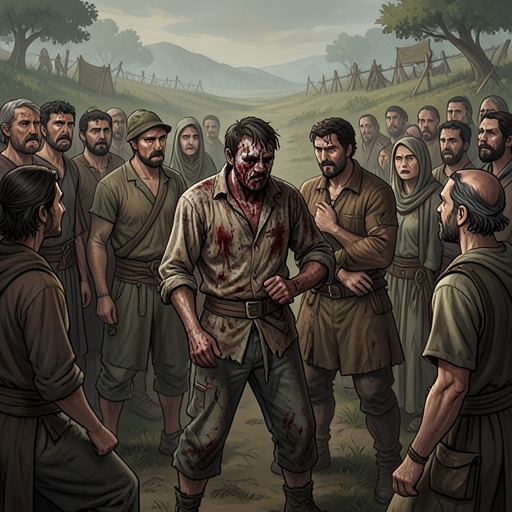
Winter removes even the precarious labor by which he might have survived. The work of the woods and fields is interrupted, and neighboring farms refuse to hire him for threshing grain, cutting wood, or driving the plough. The refusal is attributed to the fatality attached to the Wulfric name. Employers answer him with insults, taunts, and threats; dogs are released to tear at his limbs; even the alms ordinarily given to professional beggars are denied him. Poverty thus becomes active persecution, making starvation the result of a community’s decision rather than of nature alone.
At this point the narrative presents Hugues with two apparent alternatives: death from inanition or suicide as an escape from hunger. He would have chosen suicide as a final consolation if love had not held him to earthly life. His exclusion has begun to turn inward, compelling him to hate humanity in the abstract and to feel a savage pleasure in warring against it. Yet that hatred is not the whole of his character. The same man who has lost confidence in a Heaven that appears indifferent still clings to life because he loves, and love becomes the single counterforce to the poverty that has otherwise made the grave seem preferable.
Poverty and the Transformation of the Body
The material effects of deprivation are written onto Hugues Wulfric’s appearance. He would have been the finest youth in the district of Kent, but repeated outrage and privation drain the color from his cheeks and sink his eyes deep into their sockets. His brows remain contracted, and his glance becomes oblique and fierce. Nevertheless, the narrative refuses to let poverty erase his physical presence: beneath the tattered clothing are robust, harmonious shoulders; his hair remains abundant and waving; his carriage is firm and majestic; and his naturally soft voice retains a rustic grace.
This contrast makes poverty both a social condition and a visible misreading. The community sees the marks produced by hunger, violence, and despair as confirmation of alleged atrocity, while the description allows the reader to perceive the person beneath the accusation. Hugues’s altered body does not prove guilt; it records the pressure exerted upon him. The narrative’s emphasis falls less on an intrinsic defect than on the environment that has made his face haggard, his manner defensive, and his future nearly impossible.
Exile, Rank, and Subsistence Hunting
A parallel form of poverty appears in the hidden household of the old Chateau at St. Yrieux. A peasant and his daughter, Adéle de Marcanville, arrive from Normandy in the deepest poverty, though they neither ask relief nor voice complaint. They avoid conversation with neighbors and fellow residents, and they are admitted only because they can place reasonable security for payment with Gervais, the Baroness Joliedame’s steward. Their isolation is less openly communal than the Wulfrics’ exclusion, but the result is similar: poverty confines them to a neglected space and deprives them of sympathy.
The father lives as a hunter in the neighboring mountains and forests, visiting the town only occasionally to bring Adéle part of the spoil on which both depend. His apparent identity as a rough peasant is complicated by moments of haughtiness that seem like remnants of a higher station. In fact, he is Gaspar de Marcanville, once the friend of Francis I of France and a Knight of the Holy Spirit. Exile has not simply reduced his income; it has severed him from rank, court, public recognition, and the visible signs of his former identity. He tries to conceal his indigence, but his absence from St. Yrieux and dependence on the forest make it unmistakable.
Gaspar’s poverty originates in political betrayal. De Saintefleur falsely causes him to be blamed for an attempted treasonous act, and Gaspar is degraded and banished after refusing to speak words that might incriminate his former friend. He retreats with Rosalie de Marcanville and Adéle de Marcanville into the dark, almost boundless recesses of the Hanoverian Harz. The treasures he is permitted to take into exile are little more than his wife and daughter, so the household’s remaining wealth is human attachment rather than property.
Survival, Loss, and Narrative Significance
In the Harz, Gaspar draws up a faithful account of De Saintefleur’s treachery and obtains a certificate from Father Aegidius to support its truth. He gives the document to his wife, instructing that it be delivered to Francis I of France if he dies during one of the hazardous excursions required to obtain their daily subsistence. The document represents a possible restoration of rank and estates, but it cannot feed the family in the present. Until justice becomes possible, survival depends on Gaspar’s body and skill.
Years of hunting make him capable of killing the wild buck with his spear and overcoming the bear. The narration measures his poverty through the dangers he must master: if he had been responsible only for preserving his own life, he might have surrendered to famine or to the hungry wolf, but Rosalie de Marcanville and Adéle de Marcanville bind him to existence. His labor is therefore both an economic necessity and an expression of paternal and marital obligation. Like Hugues Wulfric, he continues living because attachment interrupts the logic of despair.
Gaspar’s fate nevertheless produces another form of deprivation. His grief and repeated fits of vehement passion wear upon Rosalie de Marcanville, whose death about ten years after the exile leaves him a widower while Adéle is scarcely eighteen. The household loses not only a source of emotional support but one of the few remaining members of the family’s former life. Gaspar then considers abandoning his solitude and returning to France to demand an ordeal of combat with De Saintefleur, but the sight of the changes wrought upon his body by ten years of labor and sorrow weakens his purpose. Poverty has altered him so thoroughly that even the recovery of justice must be attempted from a diminished physical and social position.
Across these episodes, Poverty reveals how deprivation is maintained by structures of reputation, class, exile, superstition, and neglect. The Wulfrics are poor because a community refuses to employ, feed, worship with, or approach them; Gaspar and Adéle de Marcanville are poor because political power expels a noble family and leaves it to survive beyond recognition. Both cases also resist reducing the destitute to passive victims. Hugues Wulfric buries his dead, seeks work, and clings to life through love; Gaspar de Marcanville hunts, preserves evidence of betrayal, and protects the possibility of his family’s restoration. Poverty destroys security and dignity, but the narrative uses it to reveal the endurance of responsibility—and the violence of a society that mistakes the consequences of exclusion for proof that the excluded deserve it.